


La nouvelle vague
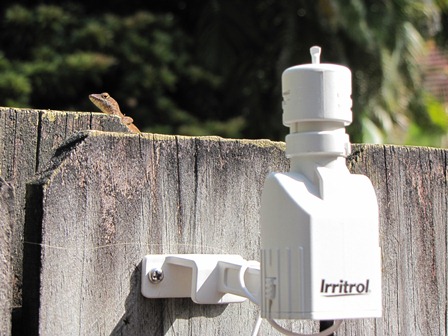 Though use of a simple rain sensor is adequate when it comes to preventing unnecessary irrigation events in automated systems, there are other more sophisticated options on the market to help reduce water waste.

Going underground: soil moisture sensor
The soil moisture sensor is a smart technology that uses continual real time moisture readings in the landscape to control whether a system will be allowed to water on schedule or not.
 On-site: weather-based timer (below), weather sensor (top)
 Jesus Lomeli: UCU schools the public
 A well installed and calibrated soil moisture sensor prevents irrigation until additional water application benefits the landscape.
 Similarly, an accurately programmed weather-based timer on a well designed system consistently replenishes the water that each irrigation zone loses to evaporation and transpiration.
 Data collecting water meters
 Roberto “Dixie” Ramirez (ValleyCrest)
Our fearless leader at Water Resource Engineering, Dr. Migliaccio let me loose on a dream project that encompassed applied science, public education, customer service, urban travel and still/video media documentation and will influence whatever work I do heretofore.

 I recently produced a new video for the Urban Conservation Unit (UCU). This micro-video revisits the topic of the multi-stream spray nozzle as a more efficient alternative to the conventional spray nozzle.
 conventional spray nozzle
 These are two critical points because the first rule in landscape irrigation is always hit the intended target! Further, due to the prevalence of head mixing in South Florida systems (putting slow watering rotors and quick watering sprays on the same zone)…
 Rotor v. spray: everyone loses!
 Before: array of sprays on a grass strip
 After: array of multi-streams on a grass strip
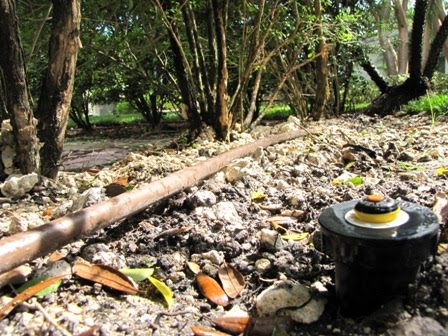 Be still my heart: drip line for a shrub zone (L) and multi-stream for turf zone (R)!
  Dr. Abtew giving a seminar at TREC
 Dr. Migliaccio showing Mrs Lehr and Dr. Abtew the instrumentation we have at site C111AE for monitoring soil water, the groundwater level at this site is monitored by SFWMD
 Mrs Dispenza explaining some of the handles experienced during weekly data downloads
 Dr. Migliaccio explaining the instrumentation we have at site AK6 for monitoring soil water and groundwater level.

 I later learned, courtesy of Dr. Michael Dukes, that much of the landscape irrigation on the UF campus uses reclaimed water. Read more about that here.
 VC1 after clean up
 VC2 Before clean up
 VC2 after clean up


