Tuesday, January 24, 2012

New video online! – mechanical timers 101

I recently produced a video for the Urban Conservation Unit. The focus of this new piece is teaching the uninitiated the ins and outs of the mechanical irrigation timer.


Ye olde time keeper


Whether on well-water or city water, 70% of the homeowner landscape irrigation systems we assess in Miami-Dade County are outfitted with a mechanical timer. Though AC-powered, these timers are as streamlined as possible...


...keeping time and day information through the use of pins and wheels, and turning on and off based on where pins are fixed and how many pins are attached in sequence.

Partners in crime


The gruesome twosome


Because all this device can do is send water and stop it, it is paired with the indexing valve in order to distribute water throughout an irrigation system’s different zones.


Exhibit A


Sworn enemy of the UCU, the indexing valve is an inefficient, unreliable and restrictive method for distributing water on a property. Does this make the mechanical timer guilty by association? Discuss among yourselves.

Carne de perro!


Despite its shortcomings, the mechanical timer does have some saving graces. First, it is built to last. Comparing it to a digital timer, one local contractor confessed to us he prefers the mechanical because it is like “carne de perro!” (tough as dog meat!).


AC power in/AC power out


Further, because many South Florida irrigation systems use pumps, the mechanical timer is advantageous because it can send 240V, or 120V, directly from the breaker to the pump – where a low-voltage digital timer requires a pump start relay.


However popular or practical, the truth about this mechanical beast is that few homeowners know how it works and even fewer know how to program it. Therein lies the motivation for producing this new video.


See it here!

Monday, January 9, 2012

New video online – demystifying irrigation maintenance!

I recently produced a video for the Urban Conservation Unit. The piece focuses on simple landscape irrigation maintenance, guiding viewers through a number of repairs step by step.

Thems the breaks!


The field plot: where we set our scene

Last year, in the wake of some especially disastrous trench-filling work at the TREC field plot (perpetrated by neither Water Resource nor TREC staff) I noticed one of the rotator heads was pulled out of the ground at a sharp angle.


As I continued to walk the plot I discovered that other heads had been completely buried under the soil used to fill the trenches. My first thought: unearth all heads and wet-check the plot for problems. My second thought: let’s make a video!

Grist for the mill


Simple enough, right? What better way to illustrate some simple maintenance tips than in a controlled environment where even we didn't know the extent of the leaning head's underground damage? Well, on that day, fortune was a sloppy trench-filler!


What began as a simple repair scene to be tacked onto other “as yet undetermined” material grew into a complete work when the subsequent wet-check revealed both a clogged rotator nozzle and a fractured zone line!


Motivation


The culprit unmasked


During our system assessments throughout Miami-Dade County, we consistently encounter homeowners who (unlike property managers) openly admit to not conducting periodic wet-checks on their irrigation systems.


Fractured pipe piece replaced


Naturally, when a nozzle clog, head break or pipe leak goes undetected, the result is often water waste, uneven irrigation coverage and landscape stress (from flooding or lack of water). Ideally, this video will help inspire enterprising folks to roll up their sleeves and do their part for water-use efficiency.


View the video here.

Wednesday, December 21, 2011

Another year

Well, 2012 is on its way and we are ending 2011. Much has happened this year and our group should be proud of each and everyone's accomplishments. Thank you to everyone for your dedication and hard work! I look forward to an exciting and productive 2012! Here are a few memories from 2011.


Isaya presenting at extension. Always an excellent substitute - and good speaker!


Kaileigh downloading data at Snapper Creek. Kaileigh was part of the NSF REU last summer and will graduate from Purdue in 2012.


Tina and the mosquitoes at C111 - don't worry she gets the data no matter what!


Teresa and I helping Isaya in C111. I miss my Brazilian friend!


And, let's not forget the water quality conference! Aime saved my life this year.


And, a big thanks to Mike who helps make us look good on the web and in film! Not to mention collect great research data!


Looking forward to an even better 2012!

Tuesday, December 13, 2011

Cultural interlude: two Spanish-language videos!

I recently produced a Spanish-language video for the Urban Conservation Unit (U.C.U.). This short work features a conservation-minded homeowner offering a tour of his self-installed and Über-efficient irrigation system – facilitated both by our recommendations and the MDC irrigation rebate program.

In with the new

When we first visited this property, all the tell-tale signs of inefficient water-use were present and accounted for:

...mechanical irrigation timer with indexing valve


...high-volume spray heads in excess - overwatering from the turf into the street and dousing established trees and shrubs in shaded areas.


Soon after our visit, the proactive homeowner took matters into his own hands and addressed all aspects of his system to increase efficiency:

...a digital timer with electric valves and a widely available “smart” add-on device replaced the old system.


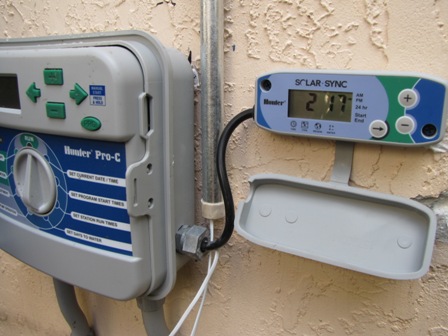
This smart add-on keeps things simple by using historical regional climate information as a base, then adjusting irrigation run-times using on-site solar radiation and rainfall information.


Spray heads in shaded areas were removed and, where necessary, were replaced with adjustable micro-sprays.


And all sprays heads on turf were removed and replaced with efficient multi-stream rotators.


But don’t take my word for it, tour the system here!

An oldie but a goodie


Dwarfing all UCU videos produced to date, a short Spanish-language work we released earlier this year about drip line irrigation is a bonafide hit!


3,000+ views and counting, this piece was inspired by a homeowner association (HOA) in North Miami Beach that went from zero to hero with its irrigation system efficiency.


Outfitted with a classic mechanical/digital hybrid timer when initially assessed, with high-volume spray heads watering both turf and hedges, it also acted upon our recommendations to improve efficiency and reduce water-use.


How? Installing the smart timer we assigned it as part of the HOA program, and replacing all spray heads with drip-line in its shrub zones.


See what all the fuss is about here!

Monday, December 5, 2011

New video online: Research and development!

I recently produced a video for the Urban Conservation Unit (U.C.U.). This short work touches upon the foundation of many of the equipment and practice recommendations we make in our daily urban landscape irrigation system assessments throughout Miami-Dade: research!


Solid research into the water savings potential of both soil water sensors and weather-based timers is not only why these devices are now available on the mass market, but also why we suggest property managers and homeowners implement them into their inefficient irrigation regimes.


And when discussing irrigation-related research in Miami-Dade County, who better to consult than our very own Water Resource team here at TREC!


The starting lineup!

The video features Masters student Nicki Dobbs introducing her field study analyzing the effects of different irrigation control devices on nutrient leaching...


...Water Resource Tech Michael Gutierrez touching very briefly upon the Landscape Irrigation Project he has been working on since 2007...


...and Dr. Kati Migliaccio offering an overview of what we do and why research is critical.

View the video here.

Tuesday, November 22, 2011

New WUEP research sites online! – Part 2 of 2

This is the second part of the report back detailing the final Landscape Irrigation Project research sites initiated this summer. A summary of the summer’s efforts follows the site descriptions.


Coral Gables (South)


When the UCU assessed this homeowner property in early summer for the irrigation rebate program, I made a solemn vow to move mountains to convince the owner to participate in the research. Why? In short, it is the research equivalent of prêt-a-porter – two zone digital irrigation system on city water! Further, the digital timer on the property is the same brand/model as the smart timer under study, so the retrofit would simply involve switching face plates and mounting the on-site weather station!


In September when the owner finally agreed, we moved on retrofitting the system. The only caveat was that, unlike any of the other properties recruited this summer, the owner chose the soil water sensor (SWS) technology over the weather-based timer!


The add-on sensor we installed is a two component sensor with one part connected to the controller and the other part wired to a valve in the field. Because valve location was not readily obvious during the initial assessment, we brought along a valve finder.


The valve finder is a two-piece apparatus. One part connects to a ground and the zone wire of the valve one is trying to locate; the second part is a wand with headphones that tracks power in the valve wire and emits a noise which grows louder as the valve location gets closer.

The equipment worked like a charm for us and once both valves were located the water meter installation began.

Unlike the evapo-transpiration (ET) study sites, SWS study sites require installation of two water meters, one for each of two zones. One zone is set to by-pass and always waters on schedule; the other zone is controlled by the sensor.


On our second visit, we focused on improving coverage and eliminating excessive heads. The following images illustrate some of this work.


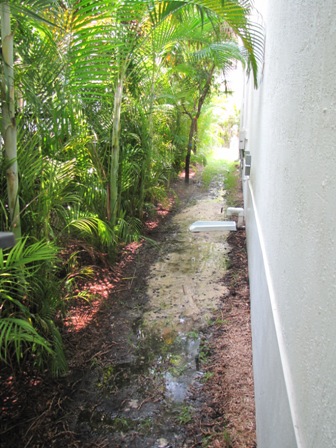
Sprays in a shaded pathway cause swamp after every event: removed!


Ridiculous spray location? More like redunkulous! Removed!

Spray head in a rotor zone: Removed!


A rotor is added to a corner to improve coverage


Coral Gables (North)

Much like the above property, as soon as I stepped onto this property for the rebate program irrigation assessment in mid-summer, I knew it was research-worthy: a five zone digital irrigation on city water.


The only catch here was that the owner had to choose the weather-based timer or all would be lost!


Why? Because there is not an inch of turf grass on this property! It’s all low-maintenance, drought tolerant shrubs and established trees, not the ideal landscape for SWS technology. In addition, the timer is located in a perfect area on the property for mounting the on-site weather station above all possible obstructions.


By August we were working on retrofitting the irrigation system for research. Our first visit was limited to exchanging the existing digital timer for the weather-based timer and installing the weather station.


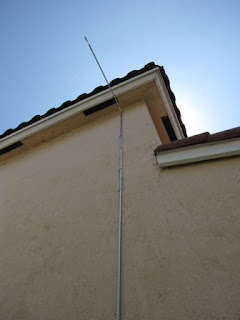
The most daunting task during the install involved scaling the 20ft garage structure to mount the weather station while racing a looming thunderstorm to the finish-line. We succeeded on both counts.


Supplies are gathered in a bucket tied to wiring


The bucket is lifted up to the roof


Weather station installation begins


All finished...with a storm on our heels!


During our second visit we completed site preparation.


We installed a backflow device to safeguard the potable water lines (despite having irrigation tied to their water main, many South Florida properties do not include this detail).


We added the water meter on the system mainline to track water-use. We also did some redesign work to improve the application rate on several of the five zones.


Smart = no mess, no fuss!


My initial suspicion about this property was correct. For a homeowner with a low-maintenance landscape but firmly committed to maintaining the irrigation system on year-round, the weather-based timer could not be more ideal. Programmed as accurately as possible (shade factor, plant type, plant density, etc.) the weather-based timer has calculated that since September, when this site went online, persistent rain is adequately replenishing moisture in the landscape and it has not allowed any irrigation events to date. 100% savings!

Summer’s summary


Eleven research sites were initiated in the summer of 2011. Of these sites, ten are ET and one is SWS. With respect to retrofitting, six sites were complete retrofits (mechanical/indexing to digital/valves) and five were partial retrofits (digital to smart/SWS). Adding these totals to the 2010 research sites (11) that elected to continue another year in the study, the active research site total is 22.


See Part 1 of 2 here.