Tuesday, August 3, 2010
GNV Travel August
Just FYI that I will be in GNV - leaving Thursday and returning on Saturday. I will be attending Nic's graduation on Saturday. I will also be attending Liliana and Kevin's final presentations on Friday. We will be saying goodbye to three good students - hopefully they will keep in touch through the BLOG and email. Good luck to everyone!

Monday, August 2, 2010
Summer of 2010 - Cut! Print it!
I recently produced a video for each of the NSF REU students who have graced us with their presence this summer. The videos cover different facets of the project that each student focused on over the past 8 weeks.

.JPG)


Kevin Koryto - Michigan State University
I'm quite pleased to have been able to collaborate with them on these shorts. Much like all their other tasks this summer, they approached the process with patience and interest and provided solid input with respect to locations and content. Upbeat attitudes like theirs make the hours in the editing room a breeze.
I'm even more pleased, however, that during their tenure here they each had several occasions to hit the streets with the UCU team and I. And they got a first-hand look at the best of times (day-long irrigation system assessments on magnificent properties - with time for lunch) and the worst of times (obscenely long drives with meager returns) in the water resource-related customer service work that I love.
This summer provided Kevin and Liliana with an invaluable undergraduate experience that should serve them well in the future.
Kevin Koryto - Michigan State University
Liliana Zepeda - Northern Arizona University
Friday, July 30, 2010

Monday, July 26, 2010
Up-coming events
Just a reminder to everyone that Nic's last day is this week! It will be very sad to see him leave (no tears!). Also - next Monday Liliana and Kevin will present their research findings for the summer. Presentations will be at 10am. I will post an announcement soon. L and K's last day will be next Tuesday and they will depart on Wednesday. It has been great having them here and we will miss them also! It is very nice to have young, energetic people to inspire us.
Classifying Snapper Creek Field Site Soil With Hydrometer Texture Test

For comparison to data collected from a tempe cell analysis, knowledge of a soils texture can give insight into the correct soil moisture curve for a specific soil.
The Snapper Creek field site soil was analysed for %Organic Matter, %Gravel, and %Sand, Silt, and Clay Content.

Soil Samples were collected at the Snapper Creek Field Site for analysis.
The organic matter of the soil was determined through the Loss on Ignition method. Three 5 gram samples were placed in dried crucibles and heated in the Muffle for 12 hours at 105 deg C. The weight was recorded, then the samples were heated for 12 hours at 500 deg C. The difference in weight between the sample at 105 deg C and 500 deg C is the organic matter content of the soil.
The organic matter of the Snapper Creek Site was 7.89%
The soil sample was split in two using a No. 10 (2mm) sieve to seperate the large and small particles. The particles greater than 2mm in diameter are gravel. The (mass of dry gravel) / (mass of dry gravel + mass of dry small particles) was used to calculate the % gravel content of the soil.
The gravel content of the Snapper Creek Site was 19.12%
To determine the % sand, silt, and clay a texture test was completed using a hydrometer.
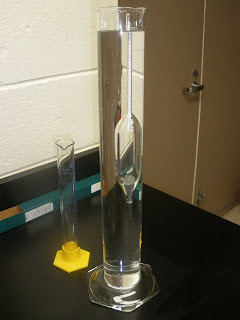
A hydrometer is an instrument that measures the specific gravity of a solution. Using a hydrometer to analyze soil texture is possible because of the principle of Stokes Law. Stokes Law states that particles of different sizes will fall at different rates in solution. By taking hydrometer readings at various times we can determine the size of the particles still in solution at that time.
Prior to starting the hydrometer test three 60 g soil samples were shaken over night in a 40 g/L Sodium Hexametaphosphate solution. The purpose of this solution is a dispersant, breaking up all of the clumped soil particles.
The soil samples were added to the sedimentation cylinders and filled to 1000 mL with DI water. One blank cylinder of DI water and dispersant solution was used to correct for variation in test conditions.

Prior to taking hydrometer readings the sedimentation cylinder is inverted for one minute to force all particles into solution.
 After inverting the cylinder the hydrometer is inserted into the cylinder and readings taken at 30 s and 60s. The 30 s and 60 s readings are taken three times by repeating the process. Hydrometer readings are taken at 30 s, 60 s, 90 min, and 24 hours.
The % sand, silt, and clay content is determined through equations relating the hydrometer readings to the desired parameters.
The Snapper Creek Soil was 63.25% Sand, 23.43% Silt, and 13.33% Clay, receiving the classification of a Sandy Loam.
Soil texture can be empirically related to soil water characteristics using equations developed in Saxton 1986 and Saxton 2006.
 Nicholas' expertise with parafilm kept the sedimentation cylinders sealed tight during shaking...
...The roof of the lab was not so lucky, as Tropical Storm Bonnie raged through TREC during the hydrometer test!
-Kevin
Tempe cell experiment to determine soil water characteristic curve of Krome soil
 Samples being saturated from the bottom in DI water to which Thymol solution has been added. Samples should be shocked for between 3 days to 1 week. The ceramic plates should be shocked for at least 24 hours.
 Kevin placing a ceramic plate into the bottom of the tempe cell, while Isaya, Tina and Robert watch. This should be done while all the pieces are submerged into a solution.
 There should be no bubbles when looking into the bottom of the tempe cell. When bubbles were noticed, the pieces were re-assembled in solution.
 While keeping the thumb finger on the horse outlet place the bottom of the tempe cell setup on to the core.
 Mike and Isaya happy after successfully assembling a tempe cell after several tries. With some little patience everything works great.
 The cheese cloth was removed from the top of the cell and replaced with a wet paper towel. The setup was then left for 2 days to allow gravity water to drain.
 Securing the tempe cell top on to the core. A good seal is important and o-rings should be greased.
Pressure regulators are used in adjusting pressures to the required settings. Water manometer is used for low pressure while the mercury manometer is used for high pressure. The tempe cell setup in our lab is designed for maximum pressures of 1 bar.
 At each pressure setting, when equilibrium is reached (i.e., no more water drains) we measure the volume of water that has fallen from the tempe to the measuring cylinder. We then use this information in generating the soil water characteristic curve.
 Thursday, July 15, 2010
Something old & something new – installations continue!
This week, one new research site was added to the WUEP pair-wise study and an older site was reinstalled.
.JPG)
With only the grasshoppers to keep us company, the day began at a homeowner property participating in Miami-Dade Extension’s Water Use Efficiency Program. This installation was a complete irrigation retrofit that encompassed the backflow prevention device, the mechanical timer, and the indexing valve.

.JPG)
.JPG)
The second installation was supposed to involve reviving a commercial property research site on well-water that went offline in early 2009. However, when we arrived at the location we learned that the sensor system on a nearby municipal water research site had burned out. This burned sensor had been providing solid water-use data since the summer of 2007. For the remainder of the day, we focused on installing a new sensor on the municipal water site - adding a few equipment flourishes previously overlooked: grease caps to protect wire connections from the elements and a junction box for easy future sensor retrieval or maintenance.

With only the grasshoppers to keep us company, the day began at a homeowner property participating in Miami-Dade Extension’s Water Use Efficiency Program. This installation was a complete irrigation retrofit that encompassed the backflow prevention device, the mechanical timer, and the indexing valve.
In the rain, we installed an anti-siphon valve with emergency shut-off option, the soil moisture sensor system, electric valves, and a water meter on each of the two experimental zones.
The second installation was supposed to involve reviving a commercial property research site on well-water that went offline in early 2009. However, when we arrived at the location we learned that the sensor system on a nearby municipal water research site had burned out. This burned sensor had been providing solid water-use data since the summer of 2007. For the remainder of the day, we focused on installing a new sensor on the municipal water site - adding a few equipment flourishes previously overlooked: grease caps to protect wire connections from the elements and a junction box for easy future sensor retrieval or maintenance.
Stay tuned for the next installation: large commercial property, soil moisture sensor add-on device, and a well-water irrigation system!
Subscribe to:
Posts (Atom)